Sunday City: Life RolePlay
- 4.5
- Rating
- 5.00M
- Installs
- Free
- Price

 Analysis by App-foxy
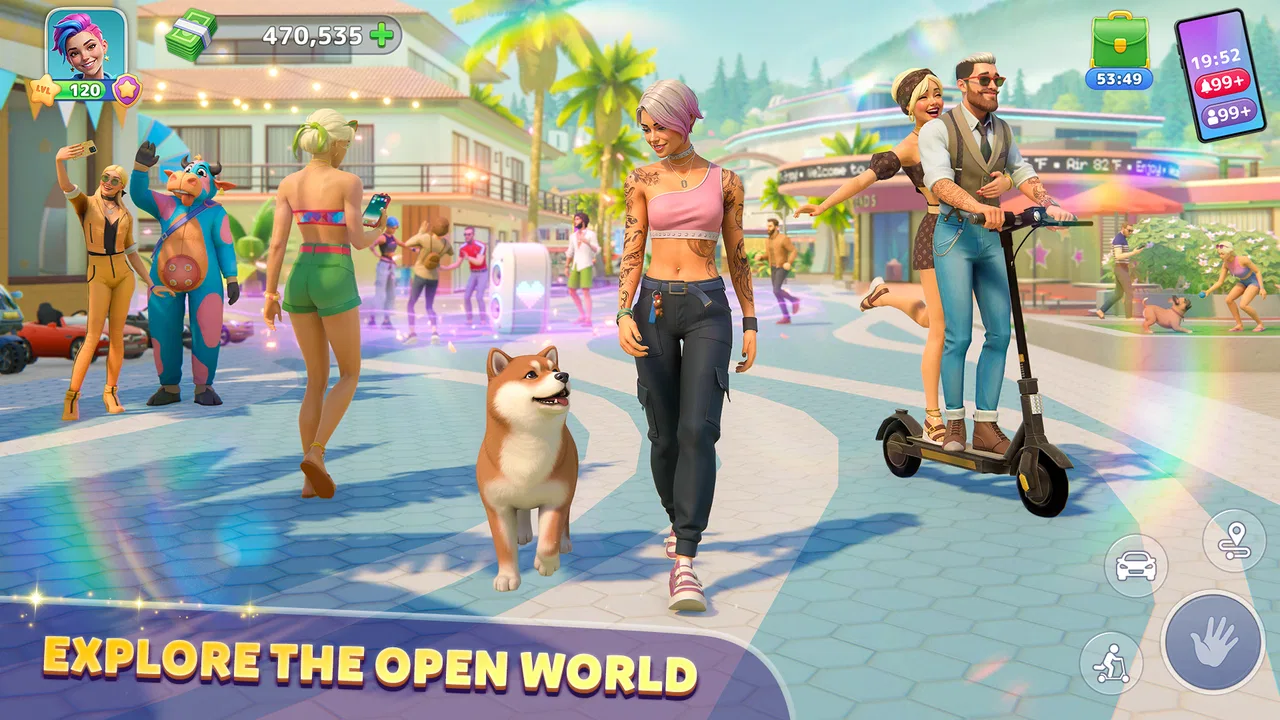
Sunday City: Life RolePlay is a simulation game from KEFIR that puts me in an open-world setting where everyday choices and business ambitions sit side by side. I can explore the city, shape a routine, and work toward building a larger business presence rather than simply completing a short sequence of levels. That combination gives the game a more personal feel than a straightforward management title.
I approached it as something to play in short sessions as well as longer stretches. The appeal is not only the idea of becoming successful; it is the gradual process of deciding what deserves my attention, how much time I want to spend exploring, and whether I prefer a relaxed role-playing rhythm or a more focused push toward progress. The result is a game that feels aimed at players who enjoy creating their own direction.
How Sunday City turns ordinary choices into a simulation
The central idea is easy to understand: I enter a city, explore its open spaces, and try to develop a business empire while living through a stylized version of real life. That broad setup gives the game room to move between personal activity and longer-term goals. Instead of treating every moment as a battle or puzzle, it asks me to think about how my actions fit into a wider routine.
You May Also Like

 Blood Strike: 2.5 Anniversary
Blood Strike’s Loadouts Turn Every Drop Into a Tactical Gamble
A close look at Blood Strike’s custom loadouts: how fast access to signature weapons reshapes its battle royale rhythm, rewards preparation, and narrows the gap between fights.

 Pandora - Music & Podcasts
Pandora’s Music Is Easy to Start, but Harder to Recover
Pandora’s strength is its low-effort path from a seed to a station. Its weak spot is how much confidence it asks you to place in connection, setup, and quiet recovery.

 8 Ball Pool
 Is Built on Rivalries, Rematches, and Routine
A close look at the rivalries, rematches, shared routines, and unanswered safety questions that turn a quick pool match into a persistent mobile community.

 Samsung Music
’s Quiet Strength Is Playing What You Already Own
Its reach comes less from spectacle than from dependable access to a personal library. That simplicity is both the app’s strongest retention engine and its ceiling.

 AccuWeather: Weather Radar
AccuWeather Review: A Quick, Clear Forecast for Everyday Decisions
For everyday plans, the best forecast is the one you can understand quickly. AccuWeather makes rain timing, radar, and local conditions easy to act on, with a few trade-offs.

 Hill Climb Racing
Why Hill Climb Racing Still Turns Crashes Into One More Run
A tiny car, a bumpy hill and one more upgrade: Hill Climb Racing keeps resurfacing because its simple chaos makes every near-miss feel personal.
More From Our News Desk



That structure is important because simulation games can become repetitive when every task has the same purpose. Here, the contrast between wandering around the city and working toward business growth creates a useful change of pace. When I want a clear objective, I can focus on progress. When I want something less demanding, exploration gives me a reason to stay in the world without rushing through it.
I also like that the role-playing angle makes the experience more flexible than a pure tycoon game. A traditional business simulator usually puts numbers, expansion, and efficiency at the center. Sunday City gives those ambitions a broader setting, so the journey is not only about improving a balance sheet. The city itself becomes part of the experience, and that makes the game easier to approach casually.
What the open-world format changes
Open-world design can be valuable in a mobile simulation because it gives me a sense of ownership over my time. I am not always being pushed through a narrow chain of menus. Moving through the city creates a break between decisions, and that makes the game feel closer to a life simulator than a spreadsheet with animations.
The trade-off is that open environments need a clear personal goal. If I start playing without deciding whether I want to explore, role-play, or concentrate on business progress, the experience can feel less directed. My best sessions came from choosing one intention before starting: explore for a while, work toward a specific improvement, or simply spend a few minutes checking in on my current routine.
This is one of the less obvious ways to get more from the game. Treating every session as a race to expand can make the slower parts seem unimportant. Treating the city as a place to pause between goals makes the simulation feel more coherent. It is a small change in mindset, but it helps the open-world format work in its favor.
A useful rhythm for short and long sessions
Sunday City suits a player who does not always have the same amount of free time. On a busy day, I can use a brief session to check progress and make a practical decision. With more time available, I can explore and let the role-playing side take over. That flexibility is particularly helpful for a mobile game, where a player may open it during a commute, a break, or a quiet evening.
For a realistic everyday scenario, imagine having ten minutes before leaving home. I would open the game, decide whether the next business step deserves attention, and use the remaining time to move through the city rather than trying to force a major milestone. Later, with a longer break, I could return with a clearer plan. This approach prevents short sessions from feeling wasted.
Longer sessions reveal a different issue: a life simulator can lose its charm if I repeat the same routine without a new personal objective. I recommend alternating between progress-focused play and exploration. That does not remove repetition, but it gives each session a different purpose and keeps the city from becoming just a backdrop.
Value when access is free
The game is free to download, which makes the initial decision straightforward. I can try its open-world role-playing and business-simulation mix without paying an entry fee. That matters because this is a style of game that depends heavily on personal taste. Some players will enjoy building a routine in a city, while others will prefer a more direct management game or a faster action experience.
There are in-app purchases ranging from $0.99 to $99.99 per item. I see that range as a reason to decide on a spending limit before playing, not as a reason to assume that every player needs to buy something. The free starting point lets me judge the core loop first. If the city, role-playing pace, and business goals do not hold my attention, spending more would not solve that problem.
The most sensible way to evaluate value is to separate free access from paid convenience or progression. The free version gives me a chance to discover whether the game fits my habits. Purchases may appeal to players who are already committed and want to spend money inside the game, but I would not treat them as part of the basic cost of trying it.
Because individual purchase value depends on how each player uses the game, I would avoid making a purchase during the first session. I would first learn the normal rhythm, see how much progress I make naturally, and decide whether the game remains enjoyable when I am not trying to accelerate everything. That is a more reliable test than judging the experience by its fastest route forward.
Where the game earns its value
The strongest value comes from the combination of open exploration and long-term ambition. Either part alone would be familiar: city exploration can feel aimless, while business growth can become a series of repetitive upgrades. Together, they give me two reasons to return. I can pursue a practical objective or simply spend time in the setting.
The simulation category also makes it a good fit for players who want control over pace. I do not need the constant pressure of a competitive match, and I can approach the experience as a personal project. That makes it more approachable than games that demand quick reactions or a fixed daily schedule.
Another strength is the way the game invites me to think about priorities. I am not only asking what I can do next; I am deciding what kind of player I want to be in the city. Focusing on business progress creates one experience, while giving more attention to exploration creates another. That personal choice is more valuable than a long checklist because it gives the setting a reason to matter.
Still, the value depends on patience. Players who want immediate variety or a clearly defined ending may find the open-ended structure less satisfying. The game is better understood as an ongoing routine than as a compact story with a final payoff. I would recommend it to someone who enjoys gradual development, not to someone who needs every session to deliver a dramatic result.
Trade-offs that matter before installing
The first trade-off is freedom versus direction. The open world gives me room to choose how I spend time, but that freedom can also make the next step feel less obvious. Players who enjoy setting their own goals will likely see this as a strength. Players who prefer a tightly guided campaign may experience it as a lack of momentum.
The second is atmosphere versus efficiency. Exploring makes the game feel more like a life simulator, but it may not always be the quickest way to reach a business objective. If I focus only on efficiency, I risk losing the part that makes the city distinctive. If I explore without any plan, I may feel that progress is slow. The best balance is to use exploration as a deliberate part of the routine rather than as accidental wandering.
The third concerns spending. Free access lowers the barrier to entry, while the available purchase range means the game can support optional spending at very different levels. I would be cautious if I am easily tempted by faster progress or if I prefer games with one clear upfront price. Sunday City is easier to recommend to players who are comfortable trying a free game first and making careful decisions afterward.
There is also a practical age consideration. The content rating is Teen, so I would not choose it automatically for a young child. That rating is relevant for families deciding what belongs on a shared device, especially when the game includes optional purchases. A parent should make the installation and spending decision with the intended player in mind.
How it compares with familiar alternatives
Compared with a pure tycoon simulator, Sunday City feels less focused on optimization. A tycoon game may be better if I want constant attention on income, expansion, and efficient decisions. This game is a better match when I want those ambitions to exist inside a broader personal setting.
Compared with a conventional life simulator, the business-empire goal gives the experience a stronger sense of direction. A life simulator can be relaxing but may feel too open if I want a clear project. Here, business growth offers an anchor while exploration supplies the freedom around it.
It also differs from a standard open-world action game. I should not choose it expecting combat, rapid missions, or nonstop spectacle. Its appeal is the slower idea of inhabiting a city and building toward something over time. That makes it less suitable for players who want immediate action, but more suitable for those who enjoy planning and personal pacing.
In other words, the game sits between several familiar types rather than replacing them. It is not the most specialized choice for business management, pure life role-playing, or action. Its value comes from combining those directions. That combination is exactly why I would try it, and also why I would skip it if I already know I want only one of those experiences.
Who is likely to get the most from it
I think Sunday City is strongest for players who enjoy gradual progress, open environments, and the feeling of managing a personal routine. It works especially well for someone who likes returning to the same world with a small objective in mind. The game gives that player enough room to decide whether today is about exploration, business, or a mixture of both.
It is also a good option for mobile players who want flexible sessions. I can approach it casually without needing every visit to become a major event. That makes it useful for people who enjoy simulation games during short breaks but still want enough depth to support a longer evening session.
Players who should skip it are those looking for a tightly scripted story, instant action, or a single-purchase experience with no optional spending structure. I would also be cautious if I dislike open-ended games where motivation has to come partly from me. The freedom that helps one player relax can make another player feel that the game lacks urgency.
My practical advice is to install it with a simple test plan. Spend the first sessions learning whether the city itself interests you, then see whether the business goal gives your play a satisfying direction. Do not judge it only by how quickly the early progress arrives. Judge whether you want to return when there is no immediate reward waiting.
Device and release details in context
KEFIR is the developer behind this simulation game. It was released on Nov 5, 2025, and the current version is 1.9.1. The minimum operating-system requirement is Android 7.0, so it is accessible to a broad range of Android devices that still support that system level.
The game has reached over a million installs, with a 4.5 average from around twenty-two thousand ratings and 856 reviews. Those figures suggest that the concept has attracted a substantial audience, but they do not replace personal testing. The important question is whether I enjoy the particular balance between city exploration and business development.
It is rated Teen and remains free to access, with optional purchases available inside the game. Those details make it easy to try, but they also reinforce my recommendation to set expectations and a spending boundary early. The free entry is the main reason I think curious simulation fans should give it a fair test.
My buying decision after playing
I would recommend Sunday City: Life RolePlay to a friend who wants an open-world simulation with a business objective and enough flexibility to create a personal rhythm. Its best quality is the way it lets exploration and ambition support each other. I can play toward growth without losing the feeling that I am spending time in a place rather than merely clearing tasks.
I would not recommend it as the first choice for someone who wants a focused tycoon game, a story-led role-playing adventure, or a completely fixed-price product. Those players may find a more specialized alternative more satisfying. The free access does make the decision low-risk, but optional purchases mean I would keep spending separate from the question of whether the core game is enjoyable.
My final verdict is to try it for free, play without rushing to purchase anything, and decide based on the routine it creates. The real value is in the mix of freedom and long-term purpose, not in chasing the fastest possible progress. If that balance sounds appealing, Sunday City has a convincing reason to stay installed. If you need constant direction or immediate action, it is better to skip it.
FAQs for Sunday City: Life RolePlay
01What is the main objective of Sunday City: Life RolePlay?
Sunday City: Life RolePlay is a simulation game where players can create and manage their own virtual lives. The main objective is to build a thriving city, interact with other players, and complete various missions and tasks to progress. Players can customize their characters, engage in different professions, and explore the dynamic cityscape.
02Is Sunday City: Life RolePlay free to download and play?
Yes, Sunday City: Life RolePlay is free to download and play. However, it offers in-app purchases that allow players to buy virtual currency and other items. These purchases can enhance gameplay by unlocking special features and speeding up progress, but they are optional and not necessary to enjoy the game.
03What platforms is Sunday City: Life RolePlay available on?
Sunday City: Life RolePlay is available on both Android and iOS platforms. You can download it from the Google Play Store for Android devices and the Apple App Store for iOS devices. Ensure your device meets the minimum system requirements for a smooth gaming experience.
04Can I play Sunday City: Life RolePlay offline?
No, Sunday City: Life RolePlay requires an internet connection to play. The game features online interactions, including player-to-player communication and live city updates, which necessitate connectivity. This ensures a dynamic and engaging environment where players can connect and collaborate.
05How does Sunday City: Life RolePlay handle player interactions?
Sunday City: Life RolePlay offers a robust social interaction system. Players can communicate via chat, participate in cooperative missions, and trade items. The game also has a moderation system to ensure a safe and friendly environment. Players are encouraged to report any inappropriate behavior to maintain community standards.
Pros
- Immersive city-building experience.
- Engaging role-play scenarios.
- User-friendly interface.
- Regular updates with new features.
- Vibrant graphics and animations.
Cons
- Requires constant internet connection.
- In-app purchases can be pricey.
- Occasional app crashes.
- Limited customization options.
- Ads can be intrusive at times.

Sunday City: Life RolePlay
Gallery